
By PVS Ltd, Dungannon. Published 1 November 2026.
The short answer: if you are buying new and a manufacturer’s crew version has the seats, load space and separation you need, buying factory can work. If you already own a van, prefer a model that is not sold as a crew version, or want the layout set up around your work, converting a panel van gives you that control. Either way, check three things: how many seats you get, what separates the passengers from the load, and how much load length is left.
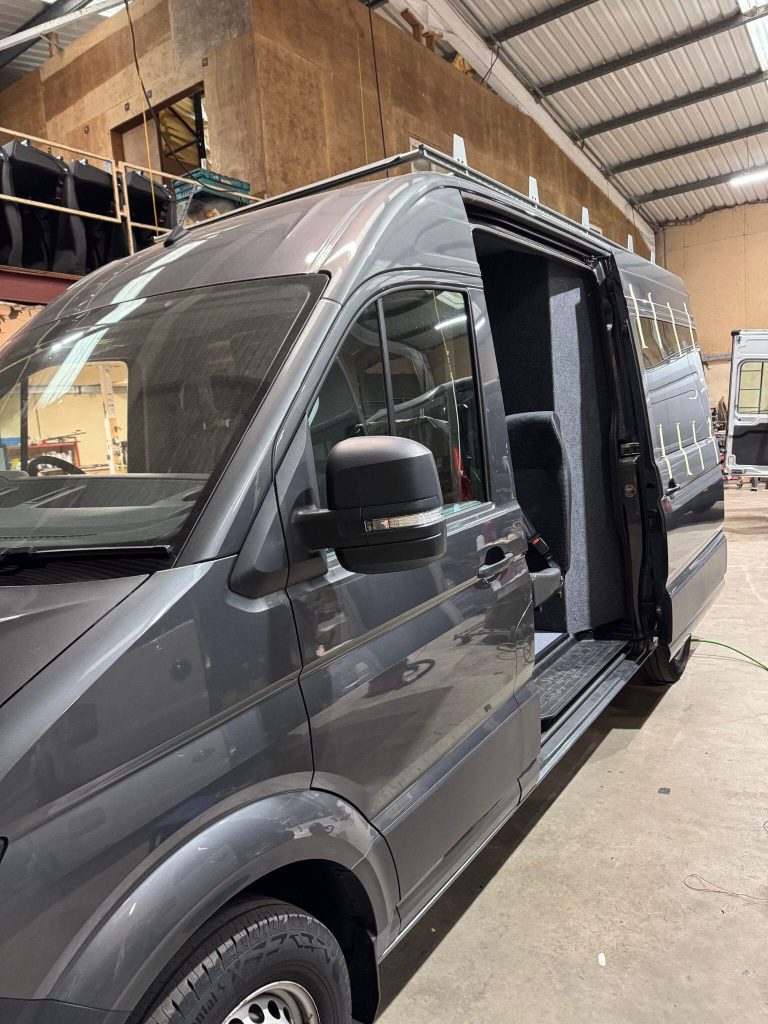
What “factory crew cab” means
Several manufacturers sell crew versions of their panel vans, with a second row of seats fitted at the factory. They are not all laid out the same way behind the seats:
- Ford describes its Transit Custom Double Cab-in-Van as having a second row for three people, with a fixed bulkhead between that row and the load area.
- Volkswagen describes its Transporter Kombi as seating five as standard (up to six), with a load area that has no bulkhead.
So “crew van” on a specification sheet can mean quite different things. If tools and materials ride in the back, check how they are kept away from the people in front of them.
When converting your own van makes more sense
- You already have the van. Converting keeps a vehicle you know rather than replacing it.
- You want a particular van. We convert a wide range, including the Ford Transit, VW Transporter, Renault Trafic and Citroën Dispatch.
- You want separation built in. Our Basic and Full conversions include a crash-tested steel bulkhead between the crew and the load.
- You want to choose the finish. Pick the Small, Basic or Full, then add extras such as additional or reclining seats, shelving or a roof rack.
- Timing. Most crew van conversions take from a few days to one to two weeks, depending on the build and the extras.
Every conversion we carry out is warranted, DVA and insurance approved, and comes with a detailed engineer’s report. Our guide to Basic vs Full crew van conversions explains how the specifications differ.
Five questions to ask before you decide
- How many people travel, and how often? A crew van suits a small team. For larger groups, look at a minibus conversion.
- What sits behind the seats? Check whether there is a bulkhead, and whether it runs the full width and height of the van.
- How much load length is left? A second row of seats takes floor space. Measure your longest regular load against the space behind the seats.
- Which extras do you need? Shelving, racking, tow bars and roof racks change how the van works day to day. See our van modifications.
- What paperwork follows? A change in seating capacity must be updated on the V5C, and insurers expect to be told about changes to a vehicle. Our checklist for carrying a crew covers both.
What we need to quote your crew van
To give you an accurate price, send us:
- your van’s make, model and year (and the registration if you have it)
- its wheelbase and roof height, for example long wheelbase with a high roof
- how many passengers you need to carry, and whether you are looking at the Small, Basic or Full
- any extras you want, and when you need the van back
Most crew van conversions take from a few days to one to two weeks, depending on the build and the extras.
Prefer to talk it through? Call (028) 8673 6969 or email mail@pvsltd.com.