
By PVS Ltd, Dungannon. Published 1 November 2026.
The short answer: before the conversion, settle the seat count and layout and speak to your insurer. Afterwards, keep the engineer’s report with the van’s paperwork, update the V5C if the seating capacity has changed, make sure your insurer has the details, and make sure everyone in the back wears their seat belt.
This is general guidance, not legal advice. For the rules that apply to your vehicle, follow the official sources linked below or ask your insurer.
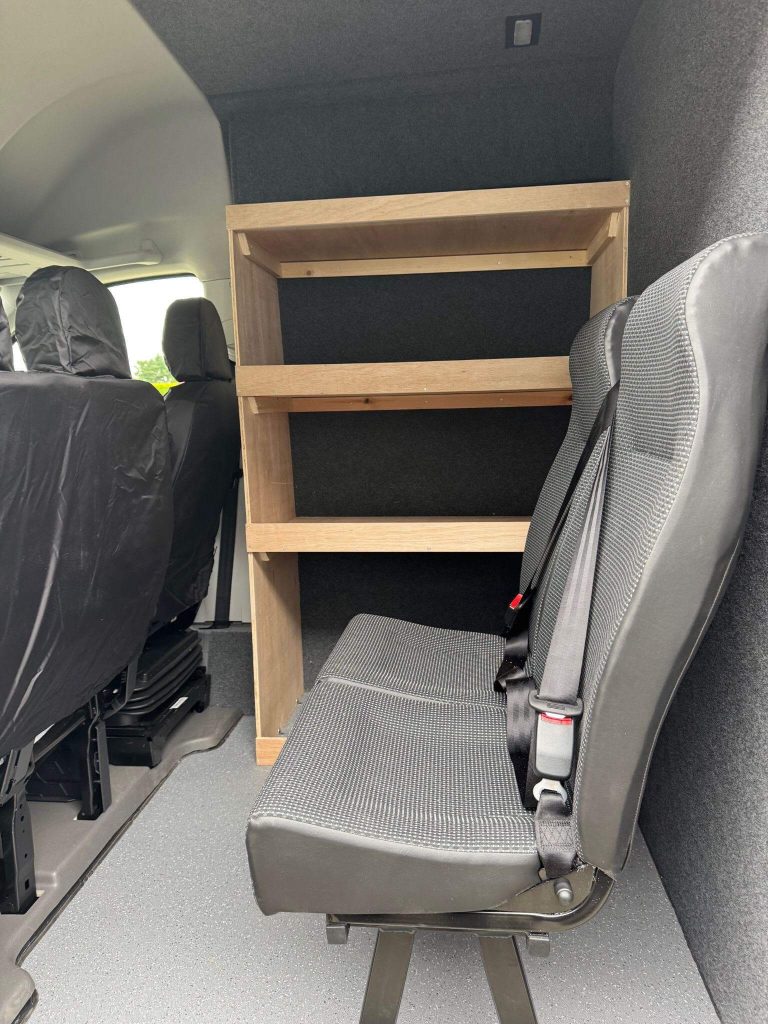
Before the conversion
- Agree the seat count. Our crew conversions start with three crash-tested seats with seat belts, and additional seats are available as an extra. Plan for the number of people who actually travel. More on seating options on our seating page.
- Decide what goes behind the bulkhead. Shelving, racking or chequer plate flooring are easier to plan alongside the seats than to add later.
- Talk to your insurer. The Financial Ombudsman Service describes a modification as a change that is not part of the manufacturer’s standard specification, and advises telling your insurer as soon as possible. Ask how a crew conversion affects your cover and premium.
Seat belts: what the law says in Northern Ireland
According to nidirect:
- drivers must wear a seat belt if one is fitted, unless they have a medical exemption
- passengers aged 14 and over are responsible for wearing a seat belt if one is available
- a driver, owner or employer may commit an offence by allowing passengers to be carried in an unsafe way in the rear of a goods vehicle
- the penalty is £500 and two penalty points for a passenger aged 14 or over without a seat belt, and £500 and three points for a driver
That is why our crew conversions use crash-tested seats with seat belts and, on the Basic and Full, a crash-tested steel bulkhead between the crew and the load.
After the conversion
Update the V5C if the seating has changed
GOV.UK lists seating capacity and body type among the details you must update on a vehicle’s V5C registration certificate. Vehicle registration for Northern Ireland is handled by DVLA, so follow the GOV.UK steps, and keep your engineer’s report to hand in case you are asked for evidence.
Give your insurer the details
Give your insurer accurate details of the conversion. The Financial Ombudsman Service warns that an undeclared modification can mean a policy is invalid and claims are refused.
Keep the paperwork together
Every PVS conversion is DVA and insurance approved and comes with a detailed engineer’s report. Keep it with the V5C and your insurance documents so everything is in one place.
Look after it between annual tests
In Northern Ireland, vans up to 3,500kg have their first annual test three years after first registration and are then tested every year (nidirect). Between tests, keep the seats, belts and bulkhead in good condition, and get any damage checked rather than worked around.
Quick checklist
- Seat count agreed for the people who actually travel
- Load area planned: shelving, racking or flooring
- Insurer contacted before the work and given the details afterwards
- Engineer’s report filed with the V5C and insurance documents
- V5C updated where the seating capacity has changed
- Everyone in the back belted up on every trip
What we need to quote your crew van
To give you an accurate price, send us:
- your van’s make, model and year (and the registration if you have it)
- its wheelbase and roof height, for example long wheelbase with a high roof
- how many passengers you need to carry, and whether you are looking at the Small, Basic or Full
- any extras you want, and when you need the van back
Most crew van conversions take from a few days to one to two weeks, depending on the build and the extras.
Prefer to talk it through? Call (028) 8673 6969 or email mail@pvsltd.com.